

While hating on hardware wallet resellers is the trending “the current thing” (next month, the in-group signaling, Elon bucks farming and general vapid virtue signaling will have moved on to something else entirely) we, as Vietnam’s (Southeast Asia – oh no! 😱 ) longest-operating hardware wallet reseller, would like to provide what we consider a necessary counterpoint.
And that point is:
The emergence of the reseller model has, on net, made hardware wallet supply chains MORE SECURE for crypto users based in the Global South.
Before we dive into the more nuanced operational and historical details (oh God, how boring! Give me some flashy, black-and-white statements to make the algo go brrrr and keep the brains running smooth!) we can already hear the screeching:
“yOu OnLy SaY tHaT bEcAuSe YoU hAvE a DiReCt FiNaNcIaL iNcEnTiVe!!!!oneoneoneeleven😡😡😡”
OK, average IQ man – move on. This article is not for you. You have loud opinions and little experience, and we do not have any incentive to convince you otherwise – you’re totally right, and we wish you good luck with it.
For those who take a more serious approach to complex matters, we would like to provide the perspective of an operator who has been “at the frontlines” of this market for close to a decade – and explain why we decided to enter this “business” in the first place.
Let’s address the financial-incentive “rebuttal” first:
While being profitable would be nice, the truth is that this is generally not a very profitable business model. At all.
If you simply want to earn money, there are literally thousands of opportunities we would recommend before becoming a retail supplier of hardware wallets.
And to be even more specific:
BitcoinVN Shop has been losing money every single year since its inception in 2017.
Without annual subsidies of $10,000 – $20,000 from our parent company BitcoinVN – Vietnam’s first Bitcoin exchange service, with a history reaching back to early 2014 – providing this service to our client base would not have been possible.
We chose to become a reseller in a frontier market as a service to our community and client base – and to provide them with more secure supply chains than they would otherwise have access to.
Especially at a time when every reseller is getting painted as some insidious middleman who is just out to insert bugged devices into the supply chain to rug their clients…
…if that were our motivation, it would be far easier, far less costly and convoluted, and far more profitable to tell our client base to simply store their coins on our exchange platform and entrust us with their custody (only to follow up at a convenient time with “we’ve been hacked”…).
When we started out, we did not even allow our user base to store any assets with us custodially at all – they were forced to withdraw to an external address right at the moment of purchase.
Sounds great in theory – if you have a 130+ IQ and very little awareness of how people with significantly less technical expertise and brainpower operate.
In practice, it resulted in countless cases of lost coins because users were sending their coins to “totallysafewallet.xyz” and other insecure setups – thereby regularly enriching fraudsters.
OK – this clearly did not work, so change of tactics.
From around 2017 onwards, we did allow users to temporarily keep their coins on our exchange platform – but in parallel, we began to invest heavily in ongoing education campaigns around self-custody and… expand our services to supply them with authentic hardware wallet devices to take secure custody of their coins.
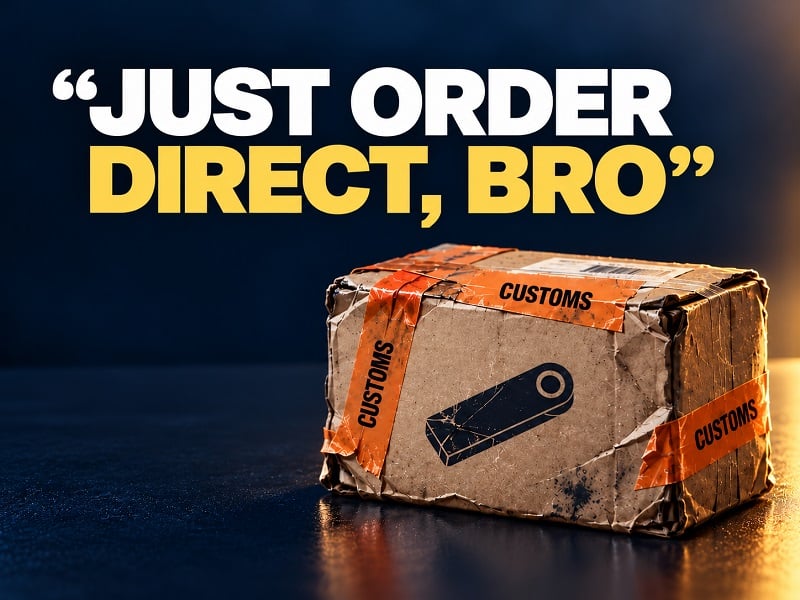
Because – once again – all you had in the market at the time were various sketchy grey market imports or the choice to order directly from overseas, where shipments would often take weeks to arrive, only to then… – far too regularly – get stuck in customs. Your device might simply get destroyed (no import license!), or you could be compelled to pay 100–200% in import clearance fees… with your package often arriving opened, damaged or unsealed at your doorstep, if it arrived at all.
This is what “just order directly from the manufacturer, bro!” means if you live in a frontier market.
And it was NOT a situation that was sufficiently frictionless to provide our customers with a smooth solution for taking self-custody of their coins.
Hence, we decided to become a reseller ourselves – and work directly with Trezor and Ledger at the time to import devices directly from them. We have since been their longest-standing resellers in the domestic market.
For our first Trezor shipment, our founding team even went in person to Prague to meet the team and pick up the devices for self-import back to Vietnam… which is – realistically – of course not always possible, as flying out to faraway countries each time stock needs to be replenished would quickly make domestic pricing entirely unaffordable.
However, we still pick up devices in person whenever we can to keep supply chains short and the number of hands the goods pass through small.
Becoming a reseller was not a “profit-driven” calculation for us – it became an operational necessity, as otherwise we would have to ask customers to either get their hands on sketchy grey market devices from unknown sources OR try their hand at self-import, which might just work if luck is on their side… or end up in a total nightmare, with many lost weeks and lost $$$ before they finally get their device in their hands – and then often not even in pristine, unopened condition.
“Just order straight from the manufacturer, bro!” sounds great in theory – but shows very little life experience outside the “developed world” bubble.
You might even get lucky with this a couple of times – do it enough times, and you will quickly become aware of the problems with this approach.
Many of the early resellers came from the early Bitcoin communities and/or the wider Bitcoin ecosystem, with a genuine desire to make the journey to self-custody easier for their community and client base – and reduce the risk of them ending up with a sketchy device in their hands.
While we do have one documented case involving a Malaysian reseller whose business appears to have been acquired by bad actors seeking to abuse its distribution network, trust and authorizations to slip bugged devices to the general public on an industrial scale… the assumption that all or most resellers are sketchy dealers out to rug their user base is, in many cases, the very opposite of why those resellers began to engage with this operating model in the first place!
We have seen firsthand, through our exchange customer base, the problems involved in getting your hands on authentic devices in a frontier market. Solving this problem – to the best of our ability – by becoming a wholesale importer ourselves, and protecting our customers from counterfeit or bugged devices ending up in their hands, was the driving motivation.
And if you believe that “ordering directly”, with all the extra complications – especially around the import – is a safer way to acquire your hardware wallet device and keeps your risk lower… well, let’s just say you are, of course, free to go ahead with that choice.
We know what we’ve seen, experienced and learned – and there is a reason why we decided to handle the import ourselves and shorten the supply chain as much as possible.
Furthermore:
Even if you do “order directly from the manufacturer”, there are still many people involved in the supply chain – any one of whom could, potentially, replace your genuine device with a bugged one.
As a concrete example:
Earlier this year, our founding team members once again traveled to another country to pick up some devices directly from the manufacturer.
However, despite repeated requests, it turned out not to be possible to pick them up directly from the manufacturer’s premises, even though we were staying in the same city.
So the devices were shipped from their warehouse to our residence – a supply chain attack could already happen here if a rogue shipper or shipping company were involved.
Then the concierge at our residence received the package – he could also, theoretically, be a bad actor capable of replacing or tampering with our shipment.
As the shipment was sent out too early – despite our request to await our arrival at the premises – it was then stored for two days in the residence’s locked and access-controlled storage room.
Anyone with access to that storage room could still potentially tamper with the devices!
Then the devices were stored in our room for several days until our return to Vietnam – here, once again, anyone with a master key for the building could enter our room and tamper with or replace the devices.
…and then, on the way back, the devices were in our checked luggage – here again, airport workers (who are known in some jurisdictions to take valuables from checked luggage to improve their meagre monthly paycheck) could tamper with the devices found in our luggage.
Do you know how long your supply chain really is when you “order directly from the manufacturer”?
As you’re unlikely to be standing right next to the assembly line in the factory when you receive your device, it may already have passed through a dozen different hands before you plug it into your computer for the first time.
Plan and move accordingly.
However, what we did avoid by bringing the devices back ourselves was what we consider one of the riskiest parts – having them potentially stuck for weeks at customs, out of our sight and control.
Generally, compromising people who repeatedly handle these devices offers a more attractive opportunity for industrial-scale attackers than compromising someone who only encounters them once.
It is rather unlikely that a random hotel worker in a random city is on the payroll of some overseas mafia… as handling these devices is not a regular occurrence for him.
Compromising customs handling in Global South countries could, however, offer a more repeatable opportunity. The people involved regularly handle imported devices – which, in our view, makes this a more attractive point for coordinated attackers to insert bugged devices into the supply chain at scale.
This does NOT mean that professional resellers are immune to similar attacks – legally importing these devices also requires customs clearance, and the same potential exposure exists.
However, as they operate at a professional scale with professional import agents, our assumption (read: not a guarantee(!!!) ) is that wholesale imports are less likely to be tampered with. In our experience, individual imports are far more likely to be intercepted and inspected by customs, while an individual customer may also be less equipped to detect any subsequent signs of malicious tampering.
Because what are you gonna do as the end customer… do you still use the hardware wallet you just ordered from overseas for 200-300$ after it was opened during customs inspection, or just ditch it?
Because the manufacturer will generally not replace it for you if customs damages it.
But if you buy from an authorized reseller – they will generally replace your device if it arrives at your doorstep damaged.
So, even while the “hatefest” against resellers is currently the popular, trendy narrative of the week on x dot com – it has very little to do with the reality on the ground in various frontier markets.
Resellers have often taken on this “business” at a rather high opportunity cost to serve their community and make self-custody safer and more accessible.
And yes, we all must plan for bad actors to continue to target, penetrate and corrupt supply chains – with ever more subtle and clandestine tactics, tools and technologies.
If this is truly the “money of the future” – you must expect that this arms race will continue to evolve.
Our general advice remains unchanged:
If you want to survive in the long term – stay paranoid.
Shorten your supply chains, yes – keep them close and thoroughly vetted.
And eliminate your single points of failure wherever possible in your custody setup.
Because even we – with, assumedly, “the best intentions” – will not be able to protect you if devices supposedly meant to help you self-custody your coins are shipped from the factory with flawed firmware, or if supply chains are compromised upstream before the devices even reach our own warehouse.
We are not under any illusions here – and neither should you be.
However, users who followed the advice to self-custody via properly configured multivendor multisig remained protected against theft through the compromised devices – both in the Coldcard case and in the more recent Ledger supply chain incident.
And maybe that is a lesson we all can – and should – learn from.