
NimDoor is a macOS malware family linked to DPRK-affiliated threat actors that was deployed against Web3 organizations and cryptocurrency businesses. While the original disclosure is no longer recent news, it remains a valuable case study in how sophisticated attackers continue to evolve their techniques against the digital asset industry.
NimDoor employed multiple techniques to evade analysis, maintain persistence, and complicate incident response. According to SentinelOne, the malware injected malicious code into legitimate processes, established multiple persistence mechanisms, encrypted its communications with command-and-control (C2) infrastructure, and selectively harvested browser data, Apple Keychain items, Telegram data, and other sensitive information.
Several of these techniques are relatively uncommon on macOS and demonstrate that sophisticated threat actors continue to invest heavily in malware specifically designed for Apple’s ecosystem. The campaign serves as a reminder that choosing macOS alone is not sufficient protection against well-resourced attackers.
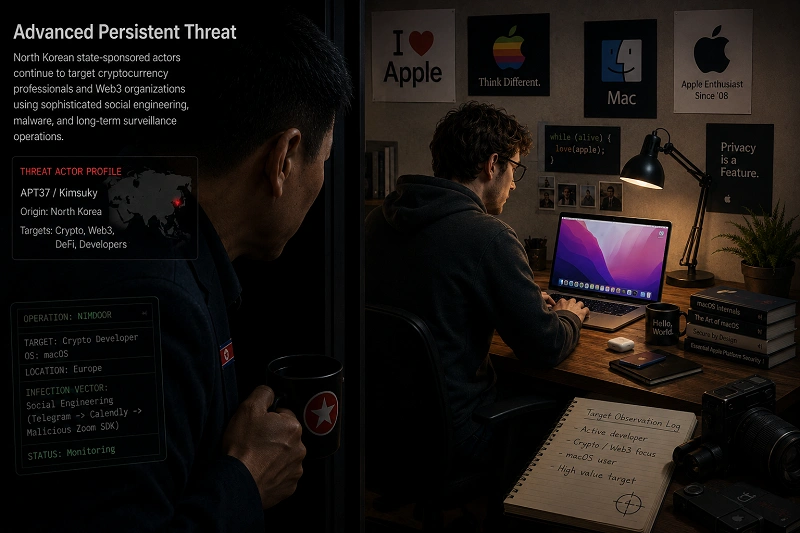
Attack Chain & Key Techniques
Initial access
The attack begins with a targeted social engineering campaign. Attackers impersonate a trusted contact on Telegram, invite the victim to schedule a meeting through Calendly, and ultimately persuade them to visit a fake Zoom-related update page before joining the call.
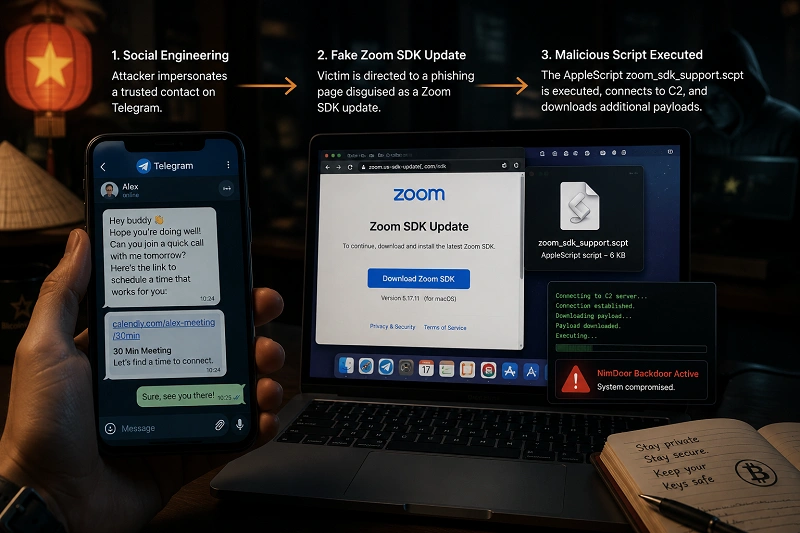
Victims are then directed to a phishing page disguised as a Zoom SDK update, which delivers a malicious AppleScript file named zoom_sdk_support.scpt from a domain impersonating Zoom. Once executed, the script connects to the attackers’ command-and-control (C2) infrastructure, downloads additional payloads, and initiates the next stages of the compromise.
What happened after infection
Once the victim executed the malicious AppleScript, the attack moved from social engineering into malware execution. The script downloaded additional malware components, one of which injected malicious code into another process while additional malware components established persistence mechanisms designed to help the malware remain active across system restarts.
The malware communicated with attacker-controlled command-and-control (C2) infrastructure, allowing the operators to issue further instructions, retrieve additional modules, and maintain access to the compromised system.
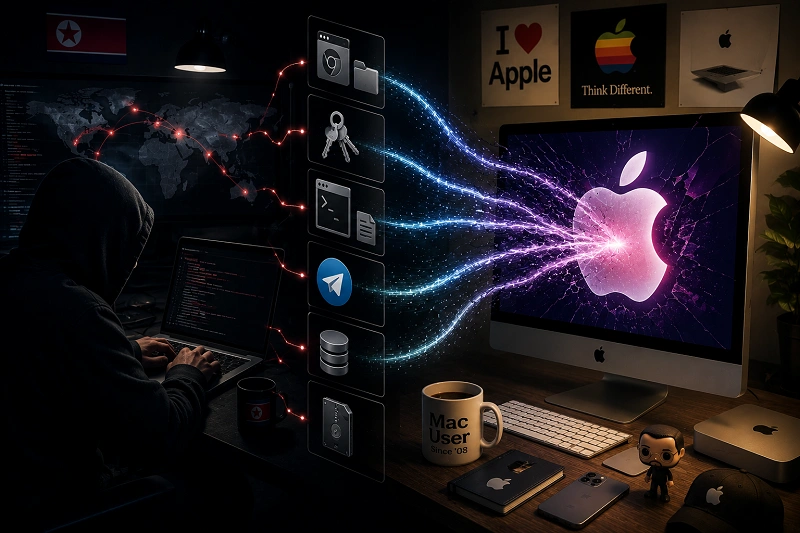
Most importantly for cryptocurrency users, NimDoor was designed to collect sensitive information from the infected machine. This included browser data, Apple Keychain items, shell history, Telegram application data, and other artifacts that could help attackers hijack accounts, steal credentials, or move deeper into a victim’s operational environment.
The Human Element: NimDoor’s Real Attack Vector
The most important lesson from the NimDoor campaign is that the attackers did not initially exploit a vulnerability in macOS. Instead, they exploited human trust.
Victims were carefully approached on Telegram by attackers impersonating trusted contacts, invited to schedule a meeting through Calendly, and ultimately persuaded to install what appeared to be a legitimate Zoom SDK update. Only after the victim voluntarily executed the malware did the technical stages of the attack begin.
For cryptocurrency users, the primary lesson is clear: a single moment of inattention is often your greatest security risk. Unless you have systems in place to cleanly separate your critical infrastructure and signing capabilities from your primary work and browsing device, a successful compromise can quickly escalate from a single infected workstation into a devastating incident affecting both your organization and your personal financial situation.
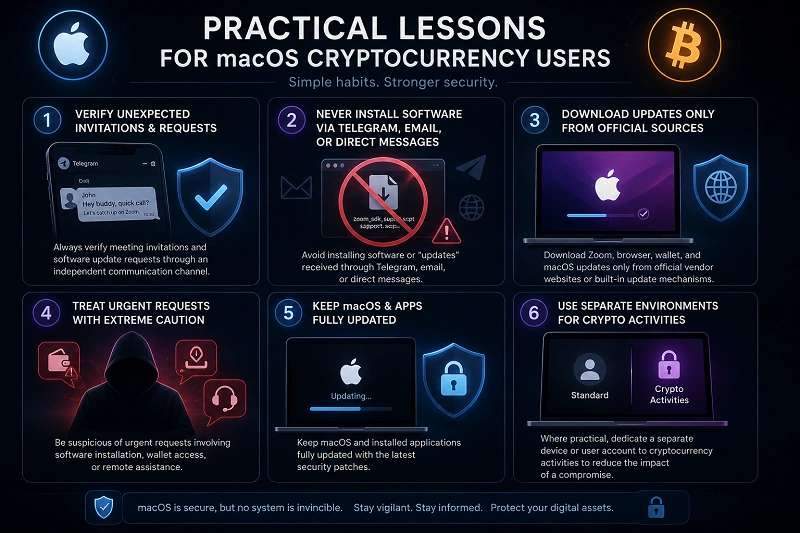
NimDoor prevention and security best practices
Although NimDoor employed sophisticated malware techniques, the initial compromise relied primarily on social engineering rather than a vulnerability in macOS itself.
For individuals and organizations working with digital assets, several practical precautions can significantly reduce the risk of a similar attack:
- Verify unexpected meeting invitations and software update requests through an independent communication channel.
- Never install software or “updates” received through Telegram, email, or direct messages.
- Download Zoom, browser, wallet, and operating system updates only from official vendor websites or built-in update mechanisms.
- Apply the principle of least privilege and avoid using administrator accounts for routine work whenever practical.
- Never store recovery seeds, private keys, or other sensitive credentials on day-to-day workstations.
- Where practical, separate critical infrastructure and wallet signing devices from your primary work and browsing environment.
Conclusion
NimDoor demonstrates the level of sophistication that DPRK-linked threat actors are willing to deploy against the cryptocurrency ecosystem. While its malware components employed advanced persistence, process injection, and data theft techniques, the campaign ultimately succeeded by exploiting human trust rather than breaking macOS itself.
The incident reinforces a timeless security principle: the strongest technical defenses can be undermined by a single successful social engineering attack. Combining good operational security, device segregation, trusted software sources, and healthy skepticism toward unexpected requests remains one of the most effective ways to defend against modern targeted threats.
Based in Vietnam and looking to strengthen your digital asset security?
Our colleagues at BitcoinVN Shop offer a carefully selected range of hardware signing devices (commonly known as hardware wallets) from leading manufacturers including Trezor, Ledger, Coinkite, Blockstream, and Keystone. These devices help physically separate your private keys from your everyday work environment, significantly reducing the impact of a compromised workstation.
Even if your everyday workstation is compromised, a properly configured hardware signing device ensures that your private keys remain isolated from the infected computer.
For long-term recovery seed protection, BitcoinVN Shop also offers durable steel backup solutions designed to withstand fire, water, and other physical hazards.
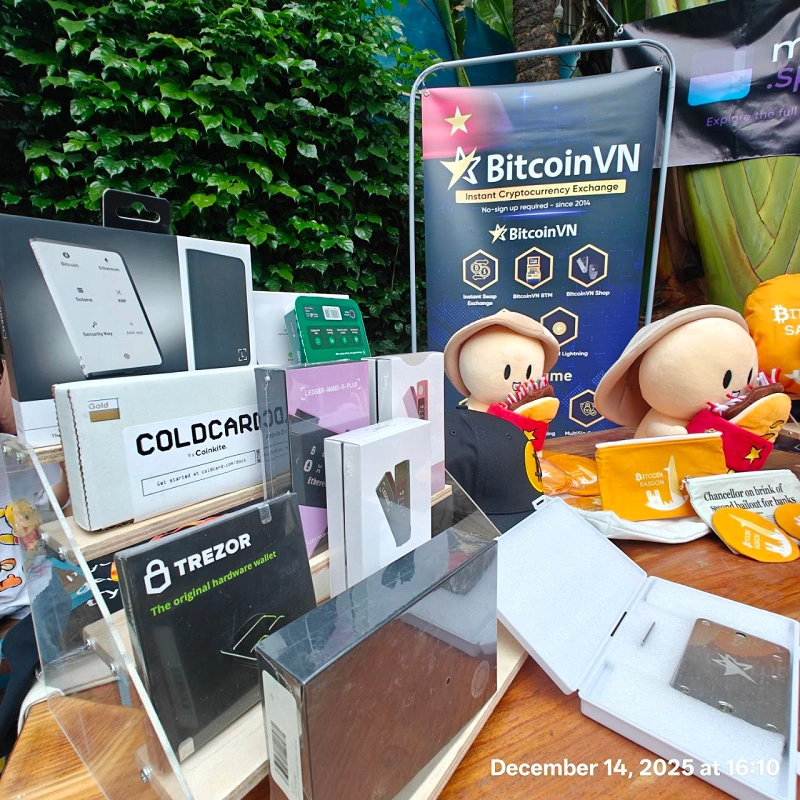
All products are dispatched directly from our Vietnam-based warehouse, eliminating the uncertainty and delays often associated with international shipping and customs.
For users who prefer maximum privacy, hardware wallets can also be collected in person from our Saigon headquarters or Da Nang showroom, minimizing the amount of personal information shared during the purchasing process.
If you are new to self-custody or would like a professional review of your current security setup, the BitcoinVN Consulting team is also available to help you build a robust operational security strategy from the outset – before a costly mistake becomes a painful lesson.