
Please note that the BitcoinVN Liquidity Pools (staking/liquidity provision products used to support BitcoinVN swap operations) are solely designed for sophisticated investors who can put capital at risk and fully understand the risks of custodial crypto arrangements.
If you’re looking to get rich quick with no risk or work involved – please move on. 🙂
It has been a while since our last update on the BitcoinVN Liquidity Pools – so we would like to provide a brief summary of some notable recent developments around our liquidity/staking product.
Expanded SOL Liquidity Pool Capacity
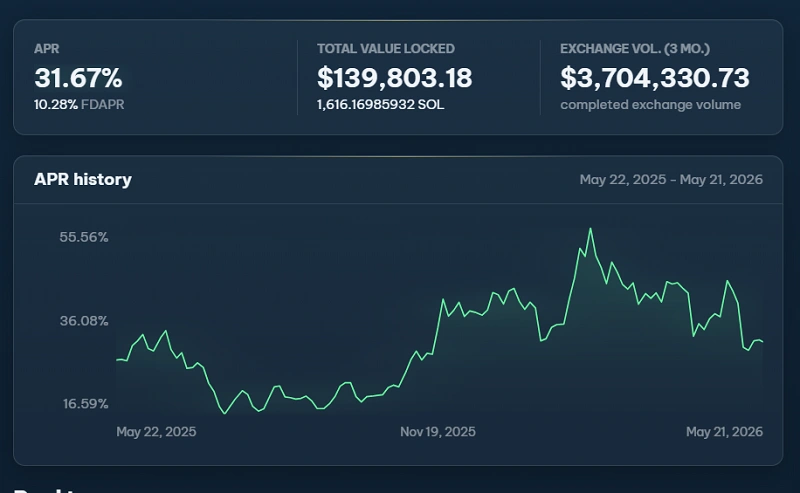
As we’ve seen increased demand for Solana (SOL) swaps on our platform, our liquidity management team has determined that the currently available liquidity remains only barely sufficient to handle operational liquidity needs.
This can also be seen in the currently high APR for SOL liquidity providers, which is – at the time of writing – the highest-APR option among our available liquidity pools.
As such, the expansion of the SOL liquidity pool from its previous 2,000 SOL limit to a new 5,000 SOL limit has been approved by BitcoinVN’s liquidity and risk management teams.
While we currently do not foresee the need to further increase SOL liquidity provision, we may – once baseline demand is sufficiently covered – cap the pool and discontinue accepting additional liquidity, as has already been the case for some time with our XMR liquidity pool.
BitcoinVN does not want to take on more custodial risk on any asset than is operationally necessary to maintain smooth exchange/swap operations. Anything beyond that merely adds compounding risk to the service without providing an offsetting operational benefit.
Overall, a crypto network is generally stronger when ownership of the underlying assets is widely distributed in self-custody, rather than concentrated in custodial balances held with centralized service providers.
Expanded DAI Liquidity Pool Capacity
While our initial plans for this year had envisaged folding the DAI liquidity pool into our unified USD stablecoin pool, we quickly received – following the publication of that announcement – feedback in both word and deed which led us to reconsider this decision.
As such, DAI has retained its status as a standalone liquidity pool – nowadays powering the BitcoinVN swap engine for DAI across Ethereum, Polygon, Arbitrum, Binance Smart Chain, Optimism, Avalanche, and Base.
While DAI itself is increasingly being phased out across parts of the wider crypto ecosystem in favor of MakerDAO’s new stablecoin USDS with enhanced compliance features, DAI continues to benefit from strong integration and network effects across the broader DeFi ecosystem – meaning demand and usage remain reasonably significant.
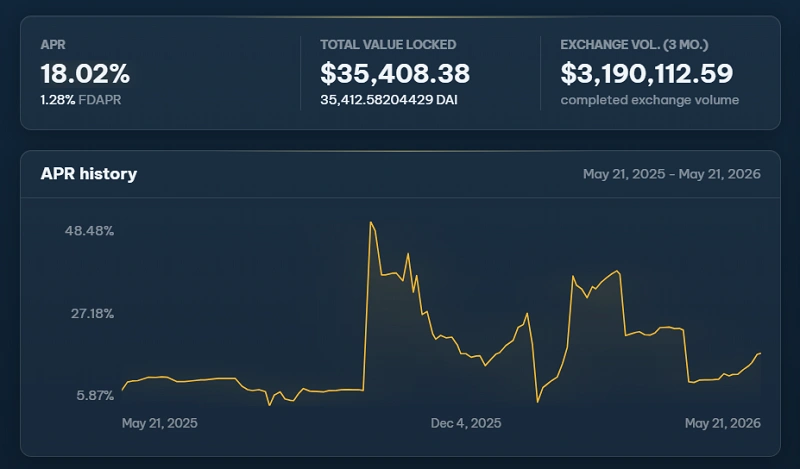
As we have come to recognize, the previous maximum cap of 250,000 DAI in our liquidity pool proved insufficient to reliably provide liquidity across the supported networks. As such, our liquidity and risk management teams have approved an increase of the DAI liquidity pool to a new maximum cap of 500,000 DAI.
Improved Staking Pool Data Visibility
We fully admit:
The previous presentation of data on our staking page was lacking and overly hard to understand.
With no historical data and unless you already knew exactly how the system worked, it was essentially impossible to properly understand the liquidity pool product and its historical performance.
We have now substantially redesigned our staking page – allowing for much clearer, per-asset information and visibility into historical performance.
Rather than tapping into an obscure “black box” with mechanics that were difficult to understand (while technically published, they were certainly far from easy to grok), users are now able to access the information they seek in a far more digestible format.
As with many things, this page also remains a work-in-progress – so if you have further feedback for us, we are always happy to hear it.
Long-Term Reward Trajectory – an Advance Warning
Now a message that will likely be less warmly received by liquidity providers in some of our currently higher-paying yield pools:
Over the coming months, we will aim to bring all liquidity pools increasingly in line with our new standard distribution fee of 5 basis points.
Previously, distributions were often as high as 50 basis points. However, as the ecosystem matures and becomes more competitive, it is necessary for BitcoinVN’s overall swap engine offering to remain competitive in the wider market.
We are currently executing a broader internal 8-point plan to drive down swap execution fees, with some measures taking effect sooner and others – as they require more substantial infrastructure work – taking effect later.
The current reward payout scheme is one of these points. While this specific adjustment may reduce percentage-based rewards for some liquidity providers, the other measures we are working on should help increase overall swap flow. A more competitive product should lead to higher usage, and higher usage may in turn support higher APRs over time.
While users will benefit from reduced swap fees on BitcoinVN, liquidity providers in pools that currently receive more than 5 basis points will, on a percentage basis, see their rewards reduced.
However, two points are important:
As we have seen in the case of Solana, lower swap fees for users can result in higher turnover on the platform – thereby increasing usage of the capital provided by liquidity providers and potentially keeping overall yields stable, or even increasing them, despite a lower basis-point distribution per volume.
Furthermore:
If you provide liquidity in a pool affected by these measures and do not agree with the new terms, you are free to unstake your liquidity at no extra cost.
For affected pools, BitcoinVN will set the unstaking fee to 0% so users who disagree can exit for free.
To be clear:
Staking pools already operating at a 0.05% distribution rate are not affected by these planned changes. Only pools with reward distributions above this level are currently being re-evaluated.
And if you want to do your part in helping improve the effective APR earned on assets you provide liquidity for, feel free to take a look at some of the strategies and tools described in our guide:
Maximizing Staking Rewards with BitcoinVN: 5 Strategies to Boost Your APR
Expanded DOGE-Related Asset Swap Capability
While DOGE is probably not a great place to store your money, the OG memecoin still has its small but committed user base, which – for one reason or another – prefers to take life, and sometimes their money, as a joke.
And who knows, maybe that alone is a preferable choice for some compared to the gloomy paranoia that is common in other corners of crypto. Maybe not our flavor, and maybe not yours – but for some, it is a valid choice.

In any case, our team recently enabled our swap engine to support “wrapped DOGE” on Binance Smart Chain.
Sounds exotic – and it certainly is. It is not something anyone who is not deep in the crypto weeds should casually mess with.
With that said, if you do – for whatever reason – happen to hold some “wrapped DOGE” on Binance Smart Chain, you can now easily use BitcoinVN to either bridge it back to native DOGE, or swap it into any other supported asset.
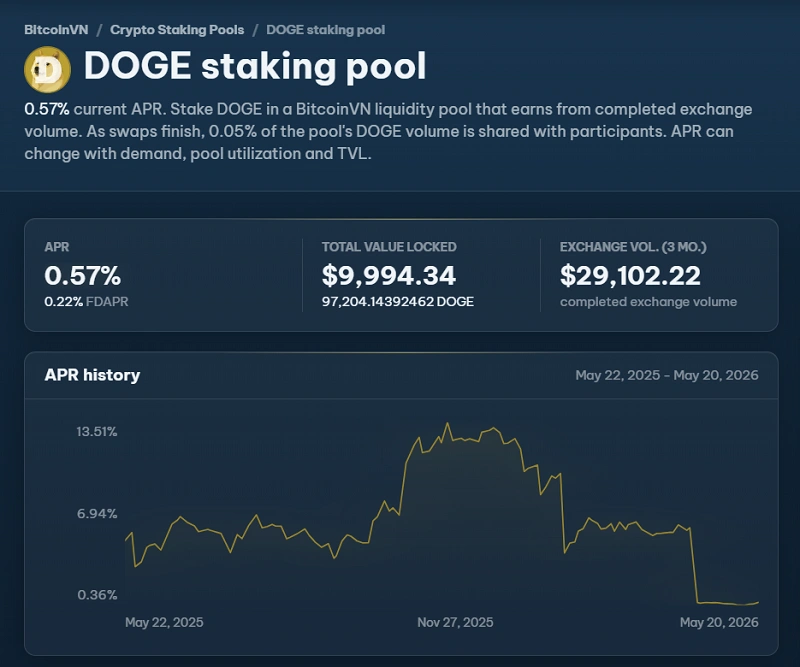
While we are not expecting a huge uptick in volume, wrapped DOGE on Binance Smart Chain will still contribute to the rewards paid out to our DOGE liquidity providers.
Whether it’s native DOGE or the wrapped version on Binance Smart Chain – each time a swap happens on the BitcoinVN platform, liquidity providers stand to benefit.
This should also serve as a risk disclaimer:
While your staked DOGE with BitcoinVN creates an obligation for BitcoinVN to repay your balance in native DOGE, it also means that we currently assume additional counterparty risk for any of our available DOGE liquidity parked on Binance Smart Chain, if Binance Smart Chain “gets into trouble” and Binance or the Binance ecosystem can no longer maintain the peg.
With that said, our risk management team has reviewed the current situation around the Binance Smart Chain ecosystem and its notable financial backers, and is currently willing to assume that risk. This allows for higher capital efficiency and thereby higher rewards for DOGE liquidity providers on the BitcoinVN platform.
It should also be noted that only a limited portion of BitcoinVN’s DOGE liquidity infrastructure currently relies on Binance Smart Chain-related liquidity operations. The substantial majority of DOGE liquidity remains held in native DOGE infrastructure.
We provide this information for full transparency. There is, of course, a tail risk that a daisy-chain reaction within the Binance Smart Chain ecosystem could lead to broader liquidity or solvency issues that might also cause losses for BitcoinVN and thereby affect our ability to repay outstanding liabilities.
Given the relatively modest scale of our current exposure, we do not currently foresee this as a substantial risk to our operations or solvency. We currently rate this as rather low risk.
With that said, our general warning stands:
If you cannot afford to lose your money, go for the self-custody route – and do not risk your capital with third parties.
Final Reminder: Not Your Keys, Not Your Coins
We started this article with a disclaimer – and we will end it with one:
While the staking product serves a legitimate purpose in the BitcoinVN ecosystem by helping provide sufficient liquidity for our swap engine to operate at scale, it also comes with risk.
Every time you entrust a third party with your funds, you assume counterparty risk.
This is a decision that should be carefully considered and only undertaken by those who can afford to put capital at risk.
While we believe BitcoinVN has built a solid operational track record over more than a decade in the industry, there is always a risk that an unforeseen event could one day impair our ability to fully meet our obligations.
You do not want to find yourself in such a position with funds you cannot afford to risk – or, in the worst case, lose.
Don’t be greedy.
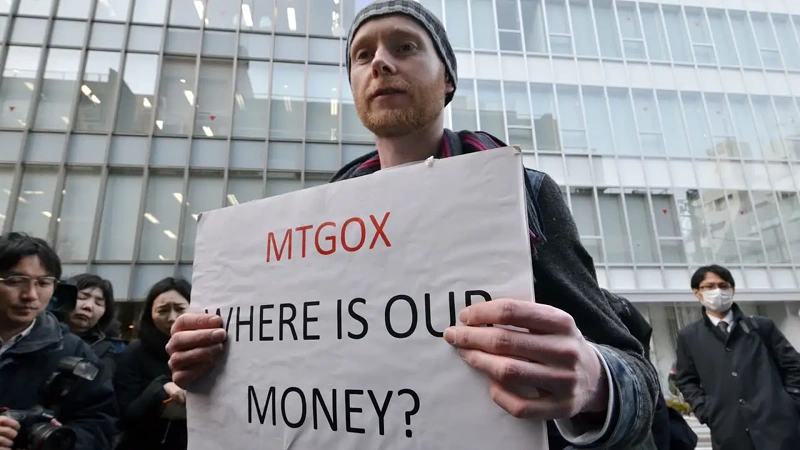
Self-custody remains the preferred way to store the substantial majority of your funds in order to eliminate counterparty risk.
If you are based in Vietnam, authentic hardware wallets from leading manufacturers such as Trezor, Ledger, or Keystone are available through our colleagues at BitcoinVN Shop – including privacy-enhancing pick-up options in Saigon (HCMC) and Da Nang, avoiding unnecessary shipping data exposure.
And if you still prefer some hand-holding to begin your self-custody journey, our in-house consulting team is available for dedicated one-on-one sessions to help get you properly set up.