If you own cryptocurrency, you should be familiar with seed phrases – the 12 or 24 words that represent your private key and let you restore your wallet. Seeds are perfectly secure as long as they are secret, but represent a significant risk of loss if discovered.
There is a way to mitigate this single point of failure: a passphrase. It’s an optional but powerful and recommended layer of security for your crypto wallets.
What is a passphrase?[1]
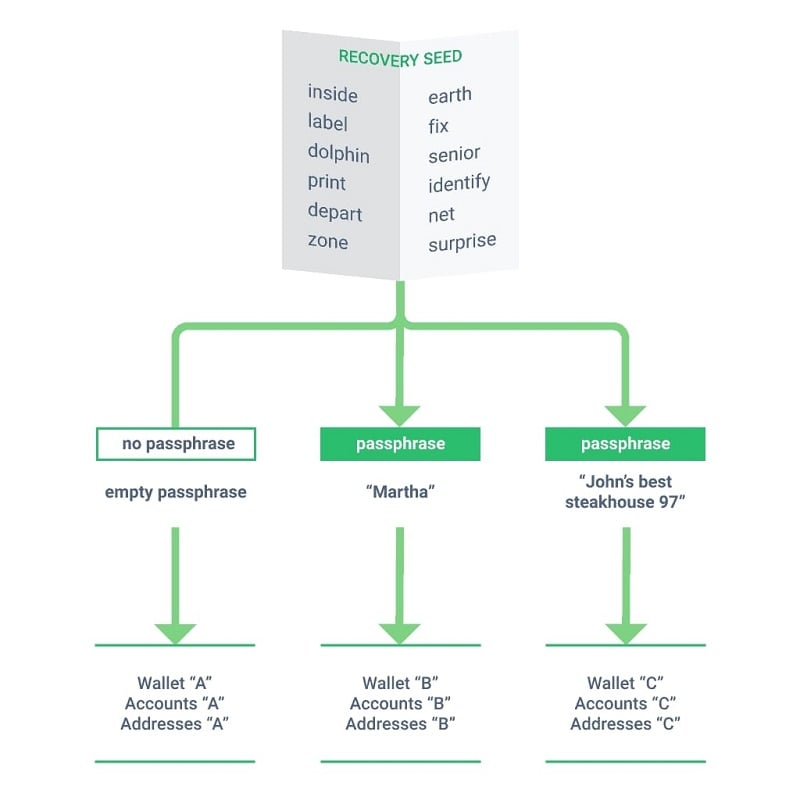
Often called a “13th or 25th word,” it’s a string of text that acts like a second key. When used, it is hashed with your seed phrase[2] to generate a completely new master private key.
A passphrase is any string of text of your choosing. It can include multiple words, spaces, numbers, and symbols, and is case sensitive. There is no limit to the number of passphrases you make. Each one will create a unique key/wallet, and each must be stored and restored precisely.
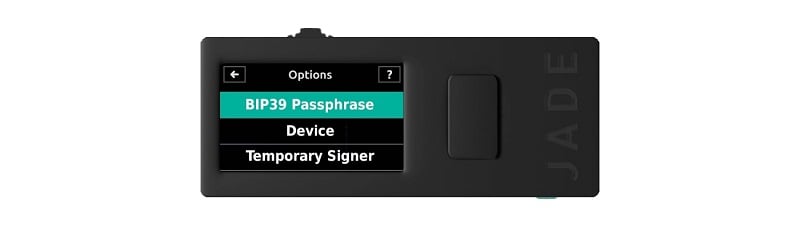
Passphrases are a part of the BIP-39 wallet standard and are uniform across all wallets and interfaces. A Bitcoin passphrase on a Ledger Wallet will also work on a Jade Wallet.
Why use passphrases?
If someone gets your seed phrase, they can only access your non-passphrase wallet. To access your passphrase wallet, they must also know there is a passphrase, find and recognize it, a nearly impossible task.
A bad actor will access your non-passphrase wallet first and take any funds there. This can warn you that your seed has been compromised, while your passphrase wallets remain safe.

This non-passphrase wallet now becomes your decoy. Put a small amount of bitcoin here, just in case you or the wallet are compromised.
How secure are passphrases?
Passphrases are only as secure as you make them. While they should be something that is easy to enter into your interface, simple is brute-forceable. It is strongly recommended to use complex passphrases of 4+ truly random words (correct horse battery staple). They are case and space sensitive, and must be entered character-perfect in order to access the same wallet.
Store your passphrase with care, separately from your seed! Due to their lack of formatting, they are not obvious to attackers like a seed phrase. Keep the seed in the safe, and the passphrase somewhere clever, preferably in a separate location entirely (like a trusted relative’s house, or a bank deposit box, etc.).
A passphrase is a double-edged sword; while it protects against a single point of failure, it doubles the number of secrets you need to track. Try to keep at least two copies of the passphrase, as losing it would be catastrophic.
Wallets that support passphrases
Both hardware and software wallets[6] can support passphrases using the BIP-39 standard, making passphrase wallet recovery compatible across devices.
Hardware Wallets
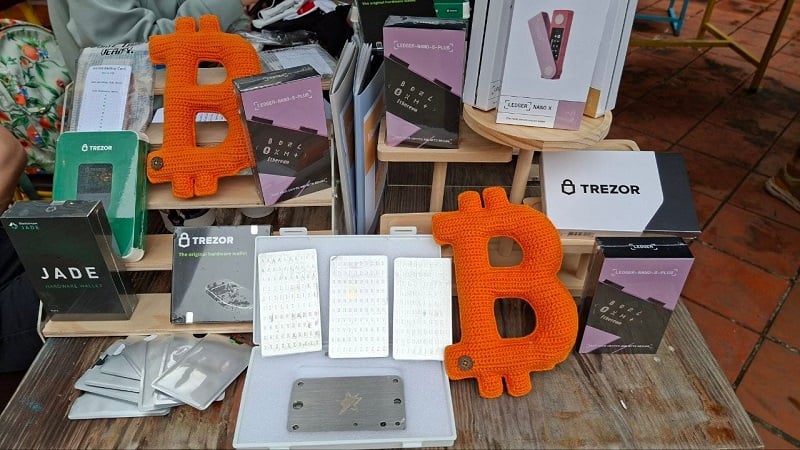
Hardware wallets are the most common choice for using a passphrase because they add an extra layer of security by keeping your keys offline. For example, Trezor, Ledger Nano X/S Plus, Coldcard, and Blockstream Jade allow you to enter the passphrase directly onto the device, so that it is never on an internet-connected device.
Software Wallets
While less secure than hardware wallets for passphrase use, some software wallets allow you to add a passphrase when recovering a wallet. This is particularly useful for recovering funds from a hardware wallet backup. For instance, BlueWallet, Exodus, Mycelium, and Samourai.
Test it first
Before sending a large amount of crypto, test your passphrase by creating the wallet and sending a small amount. Try recovering the wallet on a different device to make sure your setup works.
Don’t make it too complicated
Stick to one passphrase wallet unless you really need more. Managing too many hidden wallets increases your chances of forgetting something or making a mistake.
Conclusion
The passphrase is a powerful, double-edged sword. When you create it using a truly random method and store it with extreme care, it provides an unbeatable layer of security.
However, if you forget it, your funds are gone forever. It’s a risk with a massive reward. Treat your passphrase with the same seriousness as your seed phrase – it may be the only thing protecting your assets.
Need further guidance?
Our in-house cybersecurity team at BitcoinVN offers 1:1 consulting sessions designed to help you take full control of your digital assets – securely and confidently.
Whether you’re just getting started with self-custody, exploring advanced setups like MuSig, or want to harden your operational security, our experts will guide you step-by-step toward true self-sovereignty. No fluff, no shortcuts – just practical, Bitcoin-native security tailored to your needs.
🔐 Book your private session today at bitcoinvn.io/consulting