
Disclaimer – If you do not understand the product, we do not recommend proceeding. The liquidity pools operated by BitcoinVN are high-risk products intended only for participants who have a firm understanding of the markets, the industry and the risks involved, and who have the financial capacity to withstand a total loss of principal.
For reasons that still escape some of us here at BitcoinVN, Cardano (ADA) continues to enjoy a loyal following in Asia, roughly a decade after its original token sale.
Those of us who were around before the 2017 ICO bubble may remember the sales pitch. Buyers put up bitcoin for vouchers they could redeem for ADA once the network launched. Between September 2015 and January 2017, Cardano’s voucher sale raised 108,844.5 BTC, worth roughly 62 million US dollars at the time. Japan accounted for more than 94% of the proceeds. Across the sale as a whole, buyers aged 65 and over put in more than 3.5 million US dollars. Asking the public to part with perfectly good bitcoin for a coin that didn’t exist yet struck some of us as a highly questionable proposition even then.

A decade on, we’d still be hard-pressed to name a widespread use for ADA beyond holding it in the hope that somebody else will pay more for it later. We’ll give Cardano this much, though. Charles Hoskinson and company have kept a dedicated following through several market cycles. In an industry famous for overnight rug pulls, there’s something to be said for still being around to annoy the Bitcoiners among us ten years later.
While some of us might fail to understand the apparent charisma and sex appeal of crypto OG Charles Hoskinson, others are undoubtedly enthralled and bedazzled by it – and we have to recognise that as part of the reality we live in. You might not like it, but Hoskinson and his loyal ADA army remain a force to be reckoned with.

True Bitcoiners will – possibly justifiably so – throw up in their mouths upon reading this, but on a relative scale… crypto investors could have done worse than buying ADA.
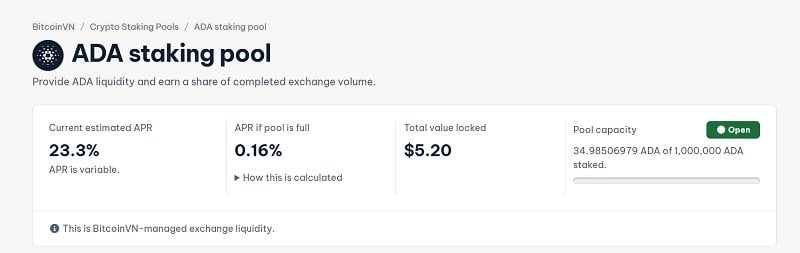
Which brings us to the new pool. Over the past 90 days, our customers have swapped six figures’ worth of ADA (measured in US dollars) on BitcoinVN. Whatever we happen to think of Cardano, those orders need liquidity to settle them. If you already hold ADA and want to supply some of those coins, you can now earn a share of that turnover.
ADA’s price performance – you could have done plenty worse
Hoskinson himself ventured into “longevity” with his family’s clinic in Wyoming. According to his brother William, Charles put nearly 250 million US dollars into infrastructure, salaries and other investments in the community. The family’s run at the longevity clinic proved rather short-lived. ADA itself, on the other hand, has turned out to be a surprisingly long-lived cryptocurrency – and plenty of coins from the same era have admittedly done worse on price.

Back when this sort of sales pitch could still get people to open their wallets, ADA was dubbed the “Japanese Ethereum”.
ICON (ICX) was the “Korean Ethereum”, Vietnam had TomoChain (TOMO), the “Vietnamese Ethereum”. Waves later picked up the nickname “Russian Ethereum”, Romania had its own contender in Elrond, and one Lisk enthusiast went straight for the whole continent, pitching it as the “Ethereum of Europe”.
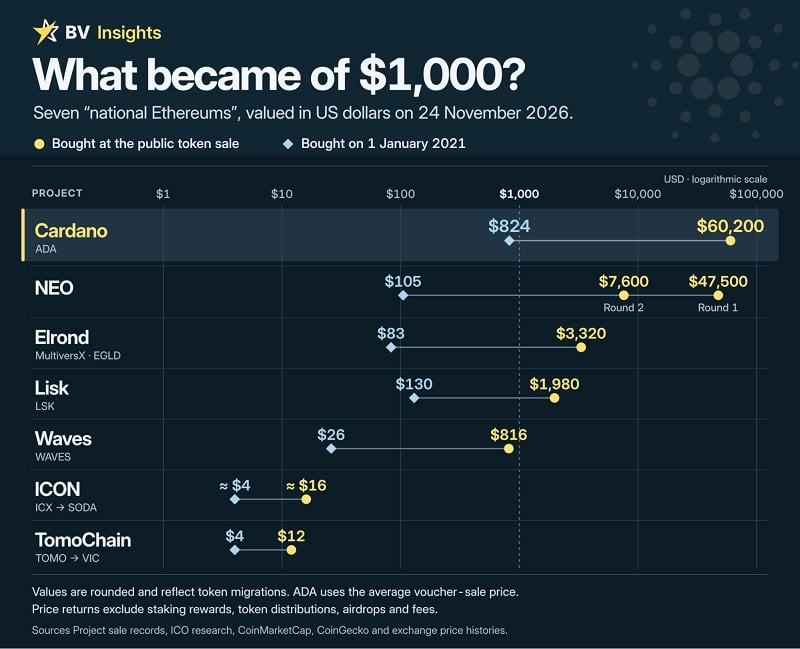
You can see (maybe…) the appeal of this approach if you were a smooth-talking “cryptocurrency project” operator looking to sell tokens to the locals. Pitch them an Ethereum of their own, and you might just turn their red-hot patriotism into cold, hard cash in your own pocket.
Brutally cynical, and probably not something a functioning society should tolerate. Yet here we are in many cases.
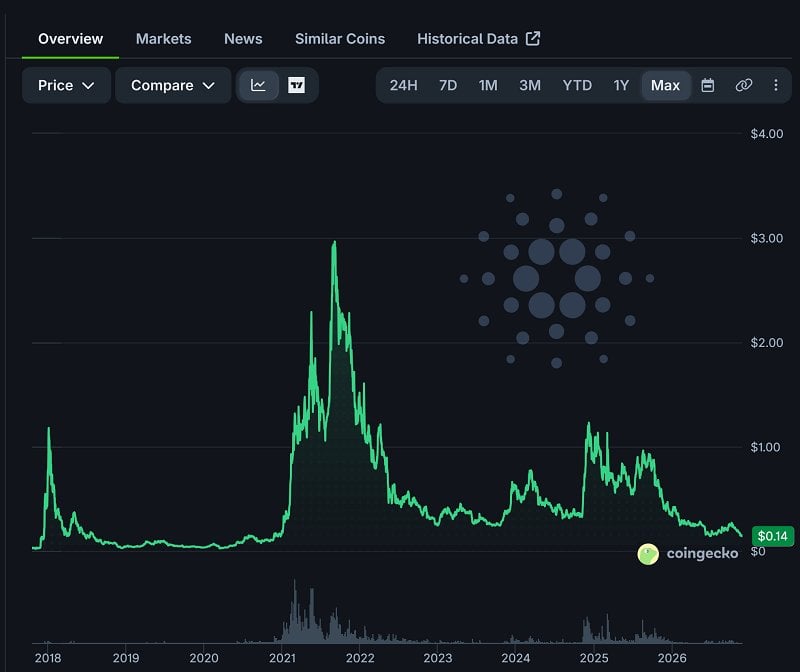
During the original fundraising drive in Japan, those ADA coins were peddled at an average price of just under a quarter of a US cent apiece. Roughly a decade later, they’re still trading at around 14 cents- about 60 times the average voucher-sale price in dollar terms.
That’s a far cry from the “generational wealth” pico top of 2021, when ADA traded above 3 US dollars a coin. Even after a decline of more than 95% from that peak, the original buyers who held on have done remarkably well in dollar terms. For a little local perspective, Japan’s Government Pension Investment Fund earned 7.69% a year in yen over the decade to March 2026 – enough to roughly double its money.
You’ve got to give them that. As sketchy as the marketing might have looked at the time, those original buyers could have done far worse over the past decade.
As for the next decade, we wouldn’t count on another 60-fold return from here however…
Now, how did it perform versus the actual benchmark, Bitcoin ($BTC)?
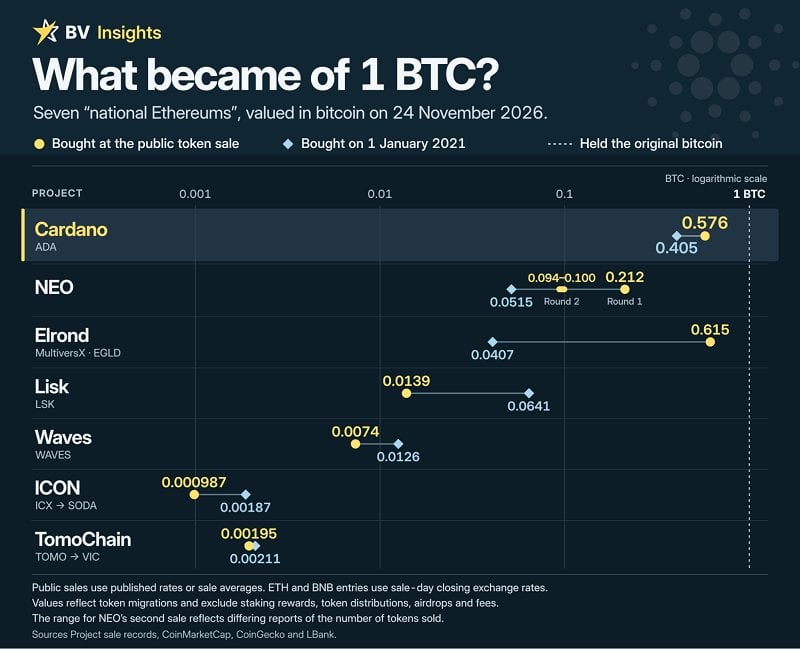
And here again… ADA looks far less terrible than one might expect. Yes, of course, you would have been better off simply hodling bitcoin, for reasons we don’t need to repeat here for the umpteenth time. But as altcoin diversions go, ADA was one of the least terrible options available if you were in the business of squandering your Bitcoin.
A decade on, if you’d handed over 1 BTC at the average ADA voucher-sale price, you could now get about 0.58 BTC back. That’s more than half your original bitcoin. Do the same maths for Lisk, Waves, ICON or TomoChain and you’d get back less than 0.02 BTC in each case.
With most of the other projects, your bitcoin became somebody else’s generational wealth when you handed it over in exchange for a token some team had just printed out of thin air.
Cardano’s voucher sale brought in 108,844.5 BTC. At the bitcoin price on 24 November 2026, those coins would have been worth roughly 6.5 billion US dollars.
And ADA’s entire market cap on that same day? About 89,000 BTC, or 5.3 billion US dollars. A decade on, if you’d bought at the average voucher-sale price and held on, you’d have lost about 42% of your original bitcoin. Compared with most of ADA’s peers, that’s astonishingly little capital destruction.
Of course, in recent years ADA has gone the way of most altcoins, slowly bleeding out against BTC… but if you got in on the ground floor, you could have done far worse, given all the terrible investment propositions the cryptosphere had to offer.
Risk disclaimer
As stated earlier, our liquidity pools are not meant for beginners or for anyone who can’t afford to lose the money they put into them.
Yes, BitcoinVN has been around for nearly 13 years and counting, and in all that time no customer has been left out of pocket over funds entrusted to us. But that means little in the current risk environment (and anyone who tells you otherwise is lying).
When you deposit ADA, you entrust your coins to BitcoinVN. You’re taking on the risk that ADA falls in value and the risk that we’re unable to return your coins. Only take part if you understand both risks and can afford to lose your entire deposit.
Do not take risks you can’t afford to take.
How the ADA liquidity pool works
You supply ADA for our swap engine to settle customer orders. In return, liquidity providers split 0.05% of qualifying ADA turnover. Say a customer funds a swap worth 10,000 ADA. That order earns the pool 5 ADA. If you held 10% of the pool when the order was funded, your cut is 0.5 ADA, paid once the swap completes.
The pool dynamics are fairly straightforward. More ADA moving through the swap engine means more rewards to go around. If more ADA enters the pool while turnover stays the same, your share gets smaller. If nobody swaps ADA, nobody earns anything. That’s why the APR on the pool page is an estimate based on the past 90 days of activity. What you actually earn depends on what our customers do next.
You can withdraw your ADA at any time. A 0.2% unstaking fee applies to funds withdrawn within three months of deposit. After that, there’s no unstaking fee.
View the ADA liquidity pool

Self-Custody ADA
Our general recommendation remains the same. You should keep the vast majority of your crypto assets in self-custody, or learn how to do so securely.
Entrusting another party with your holdings is unnecessary in most cases. And if enough people do it, control over the coins ends up concentrated in the hands of a few custodians. That undermines one of the fundamental strengths of a cryptocurrency network in the first place.
Now, you might say that in the case of ADA, this hardly matters if all you ever do is check the price. Take 21 November 2025. A malformed transaction exposed a bug in Cardano’s software. Some nodes accepted the transaction, others rejected it, and for roughly 14 hours both sides kept adding blocks to their own version of Cardano’s transaction history. Coinbase and other exchanges paused ADA deposits and withdrawals while operators updated their software and the network settled back onto one chain.
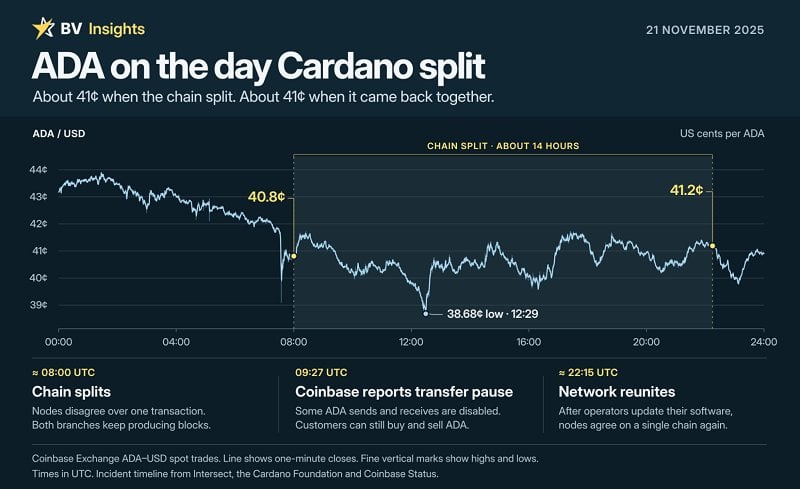
And the price? About 41 cents when the chain split. About 41 cents again by the time it came back together. There was a dip below 39 cents along the way, but if you’d checked the price over breakfast and again that evening, you could easily have missed the whole affair. If you’d spent the afternoon trying to withdraw your ADA from Coinbase, you probably had a different impression.
Then there’s the row over how Charles and the gang handled the unclaimed ADA from the original voucher sale. Cardano’s Shelley upgrade ended on-chain voucher redemption in July 2020. That December, a second upgrade moved some 318 million ADA tied to outstanding vouchers into Cardano’s reserves.

Buyers kept their right to claim, but they had to wait until November 2021, when a team began processing claims by hand. If you were one of those buyers, you’d already paid for the coins. Now you just needed somebody else to sign off before you could get your hands on them.
You can see why an early buyer might be sceptical about just how much control they had over coins they’d already paid for.
Still, being able to hold and spend your own coins remains one of the fundamental benefits of cryptocurrency. That goes for ADA, too – with the usual caveats about networks that rely on largely centralized decision-making to keep functioning as advertised.
For ADA, you can use a compatible hardware wallet from Trezor, Ledger or Keystone.
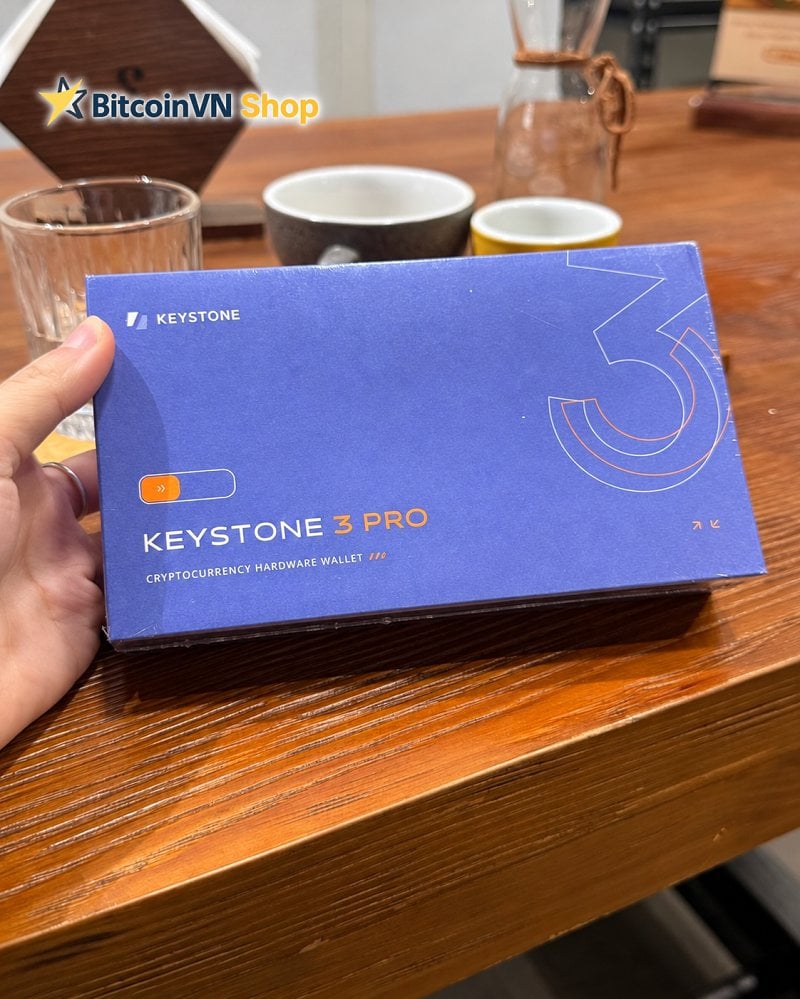
If you’re based in Vietnam, our colleagues at BitcoinVN Shop offer genuine devices for purchase and delivery, including privacy-friendly pickup at our Ho Chi Minh City office or at our showroom partner ₿itCoffee in Da Nang.
Integrate with the BitcoinVN swap engine
Building a Cardano wallet, a swap aggregator or a payment app? You can offer ADA swaps directly in your own product through the BitcoinVN API. Your users get a quote and place the order right there in your app. We supply the liquidity and send the coins to their chosen wallet.
Integration partners can also earn referral rewards on eligible swaps routed through their service. To get started, take a look at our integration page or go straight to the BitcoinVN API documentation.