TL;DR: You can now swap USDG via the BitcoinVN instant swap engine on the Ethereum, Solana, Robinhood and Ink blockchains.
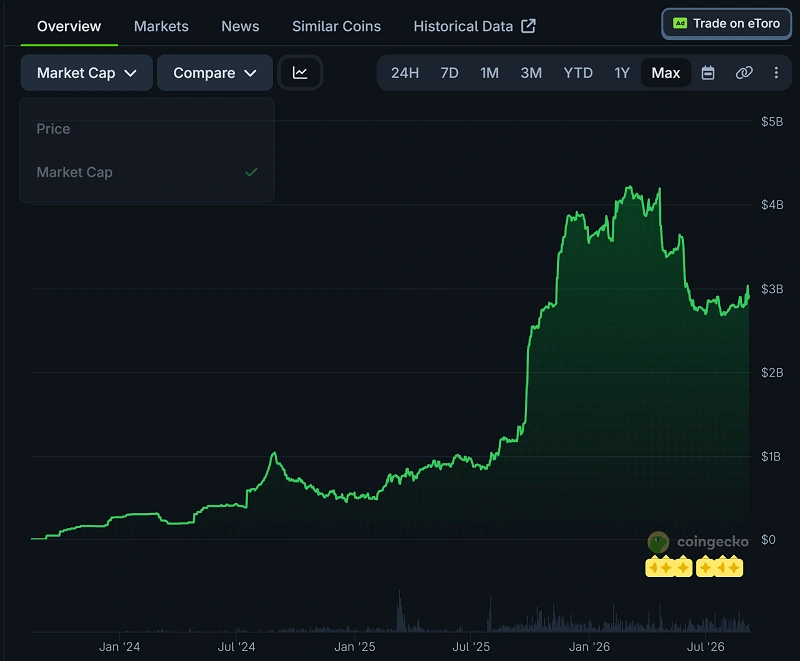
A new challenger in the stablecoin market has emerged and rapidly broken into the top 10 stablecoins by market capitalization, reaching seventh place by early September 2026.
USDG – “Global Dollar” – was launched by Paxos at the start of November 2024, just days before “crypto president” Trump won the United States presidential election. His victory raised expectations of a more welcoming environment for expansion into the crypto sector by large corporate players, old and new.
Given the strong competition from established market leaders Tether and Circle, both of which have carved out formidable positions across different market segments and geographic regions, it made sense for USDG to build a broader coalition in the race for dollar stablecoin supremacy. The Global Dollar Network brought together companies including Kraken, Robinhood, Galaxy Digital and Anchorage Digital, giving them a shared financial incentive to drive adoption.
Launching a stablecoin is one thing; getting people to actually use it is another.
USDG’s launch strategy: An alliance of distribution heavy hitters
A recognized brand and an existing customer base do not automatically translate into stablecoin adoption.
“Old Guard” fintech behemoth PayPal launched its PYUSD stablecoin in August 2023 with much fanfare. But turning an established payments brand into a widely used crypto dollar has proven a different challenge altogether.
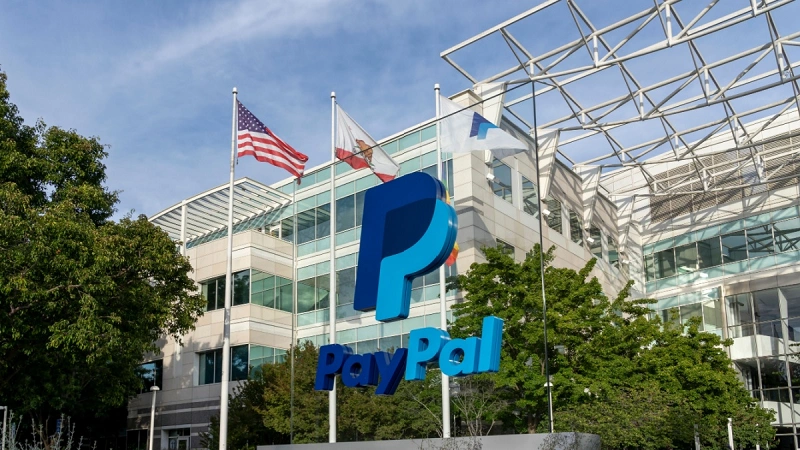
While PYUSD has, for example, been available on the BitcoinVN instant swap exchange for more than a year, its turnover on our platform has been utterly negligible compared with what USDT, USDC or DAI have been able to muster.
USDT, USDC and DAI have each carved out strong positions in their respective market segments. PayPal, so far, has not translated its enormous reach in online payments into a comparable position in stablecoins.
However, even crypto-native firms face the same challenge, as Ripple’s experience illustrates.
XRP has remained one of the largest crypto assets for years for one reason or another, and, like it or not, staying relevant is a skill in a market where thousands of other projects have faded into obscurity. But that demonstrated skill to navigate the crypto markets does not automatically translate into demand for Ripple’s own stablecoin.
Despite the huge existing distribution network Ripple enjoys in the crypto ecosystem, its own stablecoin RLUSD has so far struggled to turn that advantage into a serious challenge to USDT and USDC at the level of broader consumer and application adoption.
USDG – an alternative with an Asian anchor via Singapore
While Circle is a distinctly American firm and Tether has built a global footprint over more than a decade, USDG brings a Singapore anchor to the competition. Behind it stands Paxos, itself an “OG crypto firm” founded in 2012.
USDG launched through Paxos Digital Singapore, a Major Payment Institution supervised by the Monetary Authority of Singapore (MAS). DBS, Southeast Asia’s largest bank by assets, was selected as the primary banking partner for cash management and custody of stablecoin reserves.
For users and businesses who value an established Asian financial jurisdiction, these are meaningful credentials. USDG combines the reach of an international distribution network with an issuance and banking foundation in one of Asia’s leading financial centres.
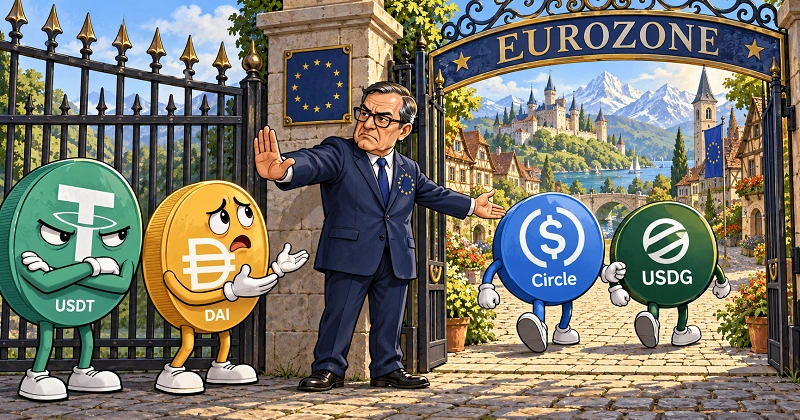
That foundation has since expanded: USDG is also issued through Paxos’s European entity under the EU’s MiCA framework, opening access to the European market in July 2025. With MiCA requirements prompting regulated exchanges to remove non-MiCA-compliant stablecoins including USDT and DAI from their offerings for EEA clients, USDG has an opening to battle it out with Circle’s USDC for market share on the “Old Continent”.
USDG and Robinhood – a summer love story of 2026
Timing and partner selection have played a major role in USDG finding its place in the crypto ecosystem – luck combined with skill leading to outperformance.
The launch of Robinhood Chain in July 2026 made the value of one such partnership much more tangible. Robinhood, a founding partner of the Global Dollar Network – and one of the younger generation’s favourite stock-market “gambling” apps – brought its brand, distribution and product experience to a market which was ready for the “next narrative”.
Tokenized stocks provided an obvious attraction: trade exposure to familiar companies around the clock, directly from a wallet, and put those tokens to work in lending pools or as collateral. Stock-market speculation with the flexibility of blockchain – and without waiting for Wall Street to wake up on Monday morning.
A boomer schedule that holds little appeal for a generation raised with a smartphone in hand every waking hour.
We don’t have to tell you why that might find an eager audience among younger, “blockchain-native” traders: familiar companies to speculate on, available through the wallets and trading tools they already use.
At least part of the market, utterly exhausted by celebrity tokens and memecoin rug pulls, was also looking for something somewhat more sustainable than “every dork and jeet” making up coins on the fly and dumping them on retail. Exposure to an actual business makes for a more substantial proposition than an unlimited supply of made-up “dogshit tokens” – even if it does nothing to stop people gambling on it.
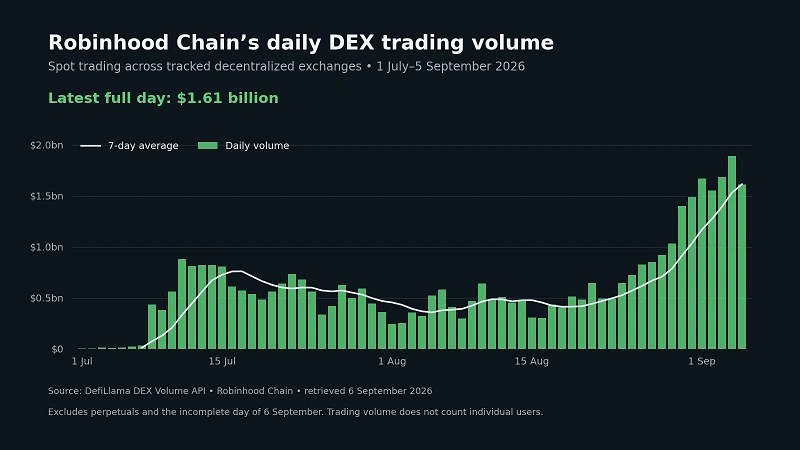
The chain attracted substantial activity out of the gate. In its two-month update, Robinhood reported $34.6 billion in cumulative decentralized exchange volume, including more than $3 billion involving its Stock Tokens. Over 190 Stock Tokens were already available. Those figures measure trading activity rather than individual users, but they give some substance to the launch excitement.
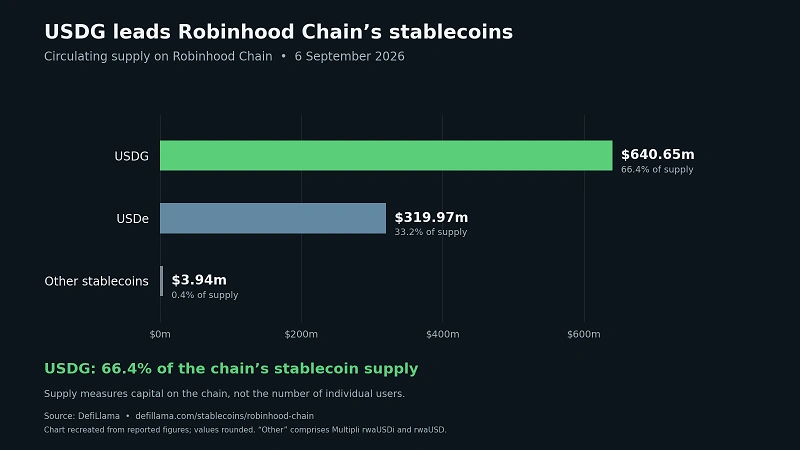
USDG also secured a prominent position within Robinhood Chain’s stablecoin market as the first stablecoin issued natively on the network.
By early September 2026, roughly $640 million in USDG sat on Robinhood Chain – around two-thirds of the chain’s stablecoin supply and one-fifth of all USDG in circulation. Its balance on the chain had grown nearly 90% over the preceding month.
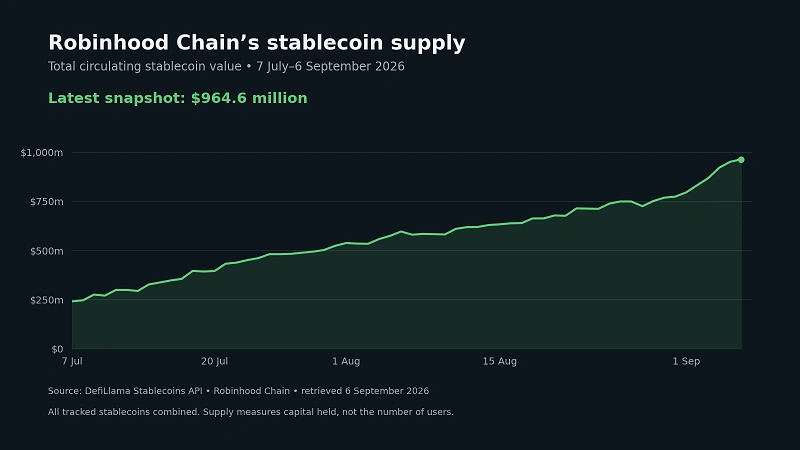
While that growth does not establish how many individual consumers use USDG, the Paxos-issued stablecoin has achieved something more concrete than another exchange listing: a substantial position in an active ecosystem where lending and trading products give users a reason to acquire it.
Robinhood Chain – “owning the venue”, the Arbitrum deal and how to position your own portfolio
Robinhood Chain runs on software developed by Arbitrum, with Ethereum underneath it to record transactions in batches. Robinhood supplies the venue, and other businesses can set up shop. Users pay the network’s transaction fees in ETH, so anyone using it directly through a wallet needs a little ETH alongside their USDG.
For Robinhood, owning the venue is where things get interesting. It collects network fees even when people trade through somebody else’s app. Of every $100 left after paying Ethereum’s settlement costs, Robinhood keeps $90; $8 goes into Arbitrum’s community treasury and $2 supports its developers.
Arbitrum gets paid for providing the technology, and those payments are already becoming meaningful. Its programme for companies running their own chains brought in $360,000 in July 2026, representing 35% of its community treasury’s income that month, as Robinhood Chain went live. That gives people following Arbitrum’s ARB token a reason to pay attention: more business on these chains can mean more money flowing into the treasury. Holding ARB gives you voting rights over how that money is used, although a small holding carries little voting weight alongside large holders and delegates. Having a vote does not necessarily mean having much influence. That makes “governance” alone a questionable value proposition for small retail investors.
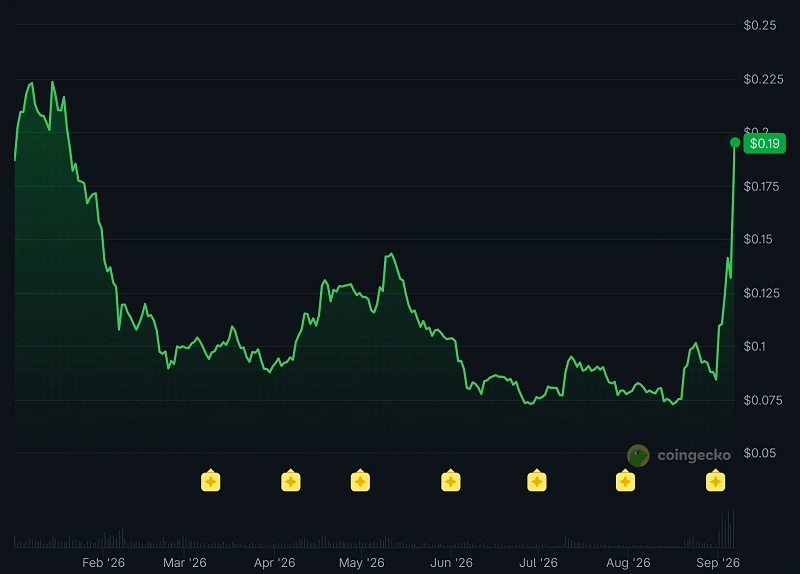
Nevertheless, after months of decline, ARB surged roughly 130% in the week to 6 September 2026 measured against “global reserve currency” USD.
In light of that rally, it bears repeating: ARB has no automatic revenue payout or transaction-fee burn mechanism. Growing income for Arbitrum’s treasury therefore does not automatically translate into financial returns for ARB holders.
While demand for ARB swaps on BitcoinVN remains limited, holders can provide liquidity through our ARB liquidity pool and earn rewards when swaps take place. Any yield comes from exchange activity on BitcoinVN and depends on actual customer demand.
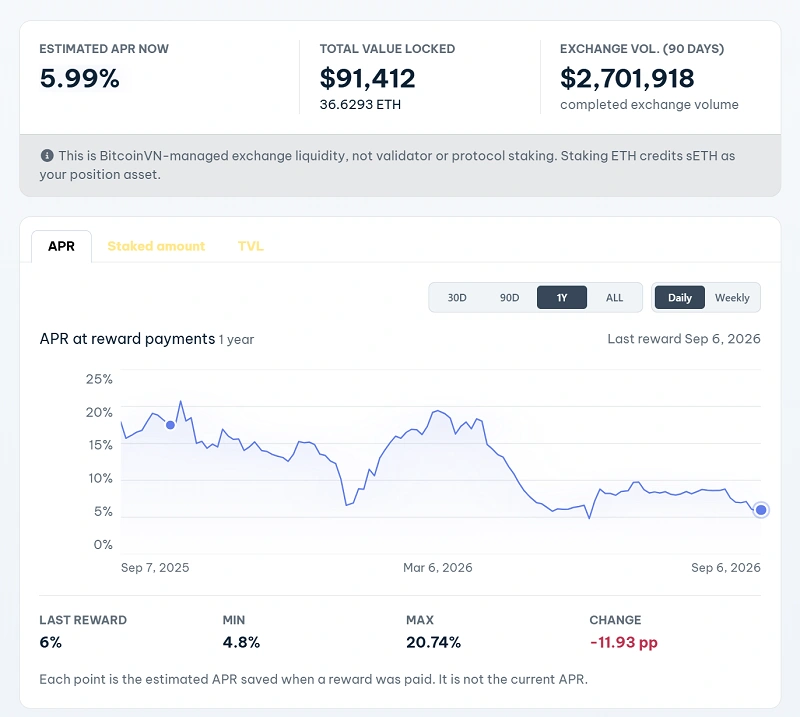
If, however, you prefer exposure to an asset with direct demand from network usage, ETH may be of greater interest. Robinhood Chain uses ETH to pay transaction fees, adding another use case for the asset. Our ETH liquidity pool lets you retain exposure to ETH’s price while earning rewards from swap activity on BitcoinVN.
Swap USDG instantly – no account, straight to your wallet
For anyone looking to put USDG to use, BitcoinVN now offers a direct route in – and back out again. You can swap USDG against other supported assets through our instant swap engine on Ethereum, Solana and Robinhood Chain, without creating an account.
Choose the network you intend to use and have your USDG delivered directly to a compatible wallet. If you’re heading into Robinhood Chain’s trading and lending markets, select Robinhood Chain as the receiving network so your funds arrive where you need them.
Swap USDG instantly on BitcoinVN
Build on the BitcoinVN API
Wallets, apps and payment platforms can integrate BitcoinVN’s instant USDG swap functionality through the BitcoinVN API.
Offer USDG swaps directly within your own product, using our exchange liquidity and automated order processing, with funds delivered straight to your users’ wallets.