
Okay, we’ll keep this one brief:
Unless you are already a committed DASH holder, you can probably skip this article entirely.
We certainly won’t attempt to persuade you to invest in this particular coin. DASH has fallen somewhat off the radar in recent years, and considerable uncertainty remains around its long-term future.
But we also won’t tell you that believing in it is “stupid.”
You’re an adult and can make your own decisions with your own capital – and we are certainly not all-knowing wizards with crystal balls.
Reasoning for DASH liquidity pool
So what’s the new offer on the table?
Straightforward – you provide liquidity to the BitcoinVN swap engine, you get paid a cut on the asset-specific turnover.
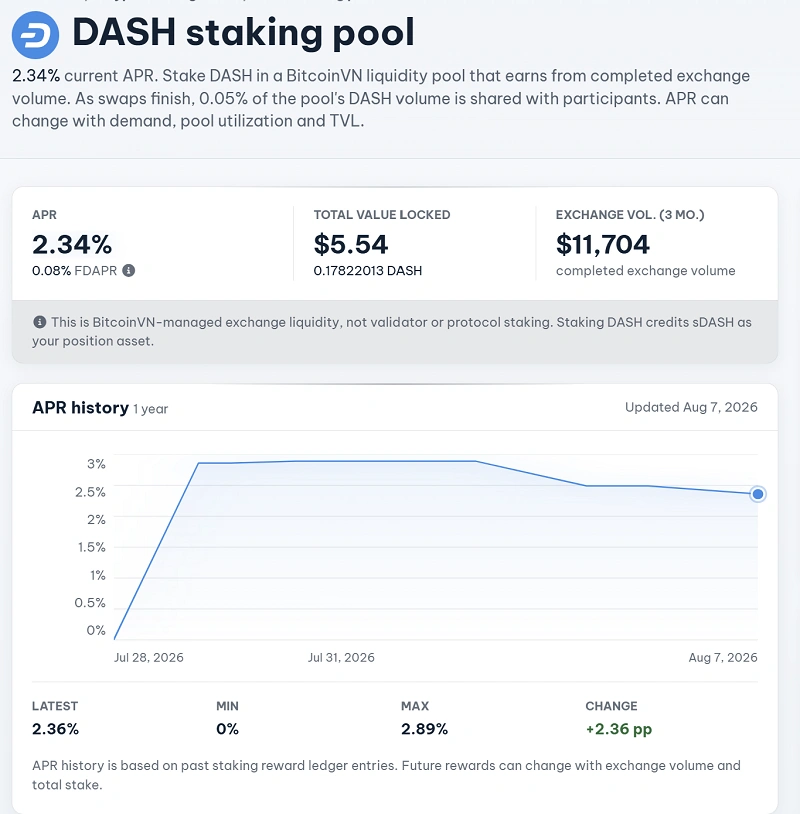
While DASH swaps generally execute instantly – you’ll usually have the coins in your wallet within five minutes – we have had rare cases where more liquidity on our side would have prevented occasional settlement delays on larger swaps.
The returns certainly don’t look impressive enough to justify giving up self-custody and turning your real DASH into an IOU claim. However:
- Greater available liquidity can substantially improve execution for larger swaps and support higher overall turnover, thereby increasing the rewards distributed.
- As such, if you’re sitting on a pile of DASH that you have nothing better to do with (and trust BitcoinVN sufficiently not to run away with your money!), you might view this as a way to support the broader health of the DASH ecosystem.
Also – to be entirely transparent – DASH is not a digital asset our firm feels comfortable holding any significant net exposure to on its own books, as our outlook on the ecosystem’s long-term trajectory is rather bearish.
With that said, do not take this as gospel. We may very well be wrong. After all, few people expected Zcash to resurge as it has over the past two years, becoming one of the very few larger coins to deliver a legitimate ten-bagger in an otherwise rather stagnant market.
To be sure, Zcash does offer some interesting frontier privacy technology. While we don’t aim to pass final judgement on “the best privacy coin of them all” in this article, it can’t be denied that considerable talent has assembled around Zcash. Using it in a shielded manner has also become significantly easier and substantially limits what the public can access and analyse about your transaction history – which may become increasingly valuable in an age of ever more powerful AI tools and analytics.
DASH price performance
Well, what should we say about this…
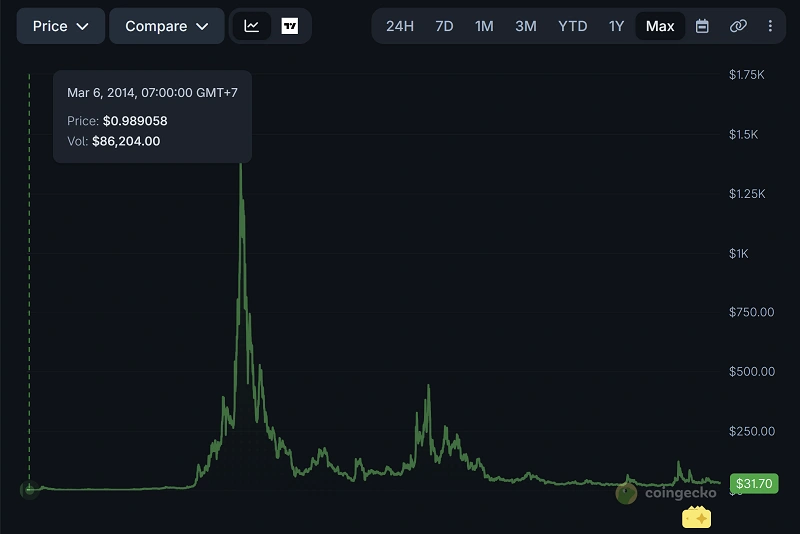
Measured from the first price point shown above, DASH is still up roughly 30x in USD terms. Bitcoin, meanwhile, is up nearly 100x over the same period. In other words, DASH has lost roughly two-thirds of its value against Bitcoin – the industry benchmark – over the past 12 years.
For an “altcoin,” this is actually one of the better long-term outcomes and remarkably resilient: the vast majority of coins from that era – with very few exceptions – have lost more than 90% of their value against Bitcoin over the same period.
Could certainly be worse from that POV. However, the broader chart remains rather ugly. DASH currently trades roughly 98% below its 2017 peak and has lost around two-thirds of its value against Bitcoin since the first price point shown here.
While there is still an active community and development base around DASH, there is little clear evidence so far that either is translating into sustained new demand. DASH did participate in the privacy-coin rally in late 2025, rising roughly 6-7x in about six weeks, but subsequently surrendered most of those gains. Monero and Zcash have retained far more of their re-rating and have dramatically outperformed both Bitcoin and DASH since the beginning of 2025.
Some might argue that classifying DASH alongside Monero and Zcash as a “privacy coin” is no longer entirely fair and has become somewhat outdated. DASH’s central proposition today is fast digital cash rather than privacy alone. The project has also continued shipping software, most notably a second-layer data network and a username-and-contacts system intended to make DASH wallets easier to use. While these are real technical developments, there is little evidence so far that they have produced meaningful adoption outside the existing DASH community, though.
The bearish issue is therefore not that DASH is dead or technically stagnant; it is that these developments have so far failed to produce enough visible adoption or monetary demand to reverse its long-term relative decline.
It is not necessarily a sign of strength when an entire sector is outperforming the industry benchmark – and DASH, which has always been grouped into the same broad category (“privacy coins”), fails to capitalize on those tailwinds.
On the other hand, some might argue that this is exactly the point:
DASH as the “undiscovered gem” of the “privacy coin” sector, potentially offering the greatest unrealized upside.
Then again, this is a topic for speculators, and our general advice remains to stay clear of speculation unless you fully understand the expected-value math behind such endeavours and have the financial capacity to take such risks with your own money without negatively affecting your life or those who depend on you.
DASH usage on BitcoinVN
While DASH undoubtedly works and fulfils its purpose as a payment coin, it may not offer the most prudent risk-reward proposition as a long-term investment (or perhaps it does; don’t take our word for it!)
With that said, where does DASH stand in terms of actual usage on BitcoinVN compared with the leading assets in the broader privacy-coin category?
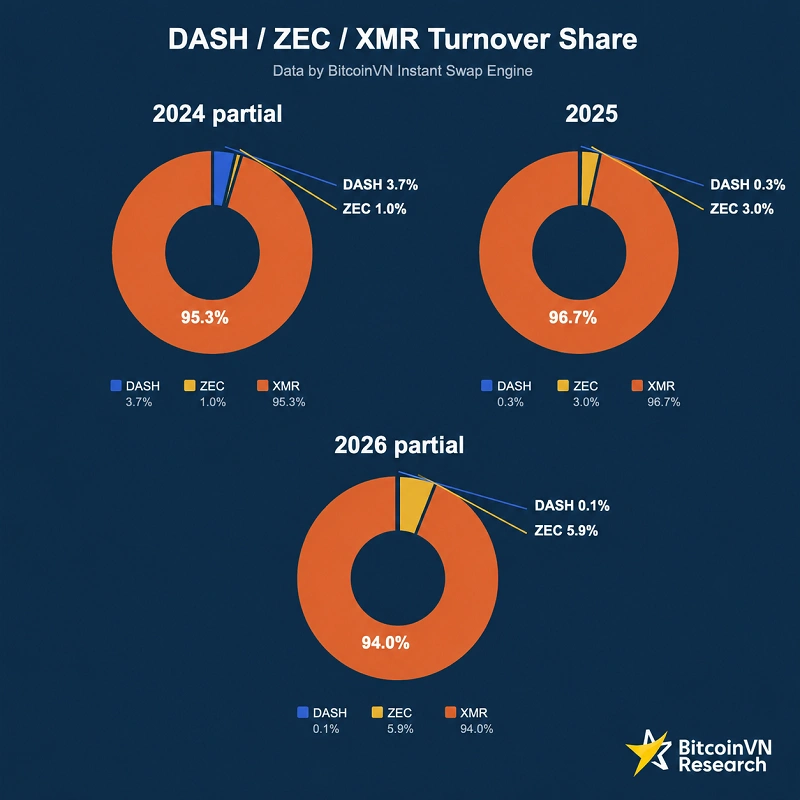
For better or worse, you can clearly see a trend that aligns with the broader market’s recent assessment of the three “main privacy coins.” While Monero crushes both of its “competitors” in terms of total volume and retains a solid 90%+ share, DASH was still ahead of Zcash in 2024 – back when the latter was similarly regarded as a “dead” or stagnant project.
The revival and rejuvenation of the Zcash project since 2025, driven by the commitment of various high-profile founders and investors in the space, have become quite visible in the numbers: by 2026, ZEC’s share of BitcoinVN turnover among DASH, ZEC and XMR had increased roughly sixfold compared with 2024, with the upward trend continuing.
DASH, on the other hand, lost significant turnover share – from 3.7% in 2024 to just 0.1% in 2026 – which lines up with the previously noted observation that it failed to capitalize, in terms of monetary valuation, on the broader bullish trend in the privacy-coin sector.
Comparing DASH usage with that of other similar-era “payment coins” that retain reasonably active communities – the original memecoin Dogecoin and Bitcoin Cash (BCH), which emerged from the “blocksize wars” of the 2016–2017 era – shows a similarly unimpressive trend.
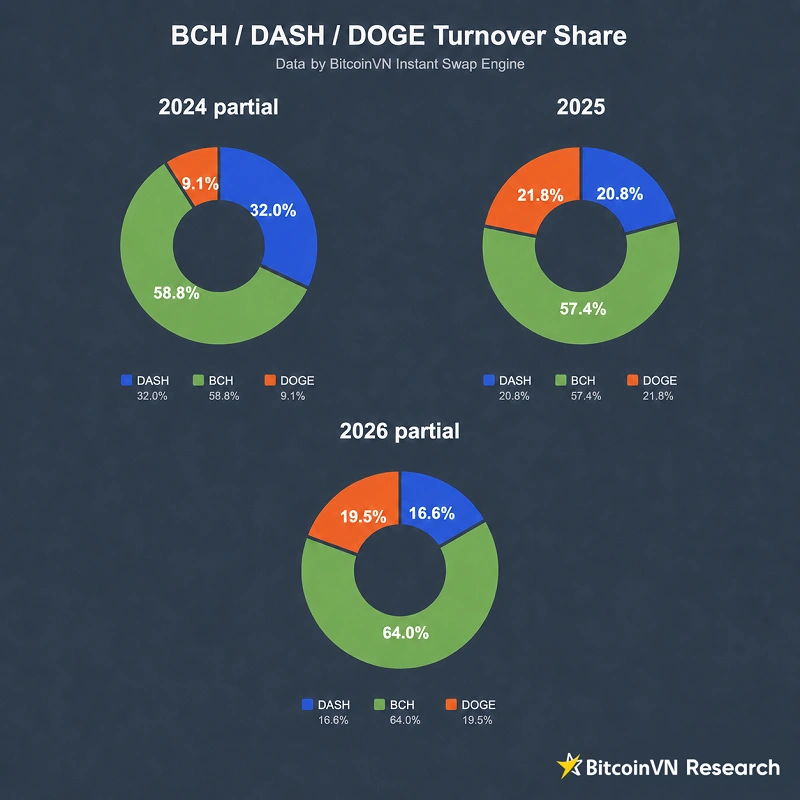
While DASH still accounted for a solid third of the combined BitcoinVN swap volume within this category in the available 2024 data, its share has since roughly halved. Bitcoin Cash now commands close to two-thirds of the combined volume, while Dogecoin overtook DASH in 2025 and remains ahead in the partial 2026 data.
While a continuation of these trends would very much point to a coin that is “fizzling out,” people thought much the same about Zcash in 2024 – which subsequently turned out to be one of the very few cryptocurrencies to deliver outsized valuation returns in the mid-2020s, creating a significant positive wealth effect for its holders.
With that said, we are not in the business of speculation, and it is up to each individual market observer to draw their own conclusions.
Which hardware wallet for DASH?
While we began this announcement with a “pitch” for our new DASH liquidity pool – intended to improve the availability of DASH for fast and larger swaps through the BitcoinVN instant-swap platform – the old mantra still holds:
Not your keys, not your coins.

If you *do* for whatever reason hold some significant amount of DASH as part of your net worth/portfolio, you want to make sure to do it right.
Securing your private keys works much the same way for DASH as it does for Bitcoin. If you know what you are doing, you can generate a wallet with sufficient entropy using the official Dash Core software on a clean, dedicated laptop that remains disconnected from the internet, and record the resulting seed phrase – for example, on a steel plate resistant to house fires and flooding – which you then store in a safe place. If, however, you want to use DASH regularly while keeping your private keys and transaction signing isolated from your internet-connected phone or computer, you might want to opt for a hardware wallet.
Please note that Trezor Suite stopped supporting DASH natively in February 2025. As such, the more straightforward alternatives with native support include the established market leader Ledger and the Asian upstart Keystone, which has been gaining traction in recent times.
Integrate DASH swap API
If you run a wallet or other service and are looking to integrate fast, account-free DASH swaps with stablecoins or other cryptocurrencies – including Bitcoin, Bitcoin over Lightning, Monero, shielded Zcash and dozens more – you can connect directly to the BitcoinVN swap engine through our API.
Integration is generally straightforward. If you still have questions, feel free to contact our team via Telegram or our regular support channels.