












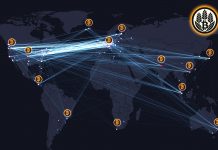












Ahead of a more thorough upgrade of our customer-facing Lightning infrastructure (currently – as you might have seen – our no-KYC swap functionality on the website remains limited to $1,000 per transaction), our team has been running more extensive stress tests on our routing nodes to ensure customers enjoy a smooth experience when depositing to or withdrawing from Lightning.
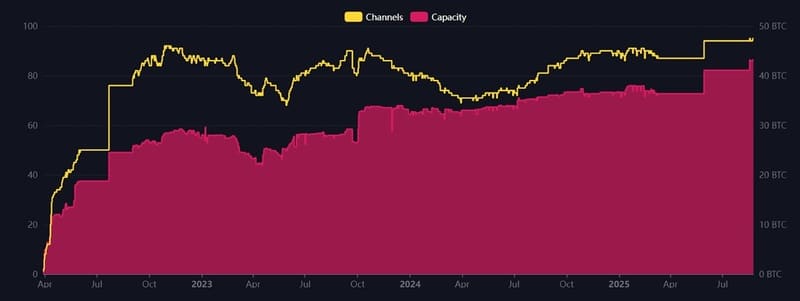
As you might know (or just learned now), BitcoinVN has for quite some time operated one of the largest Lightning routing nodes in Southeast Asia. This has been part of our preparations to provide a seamless user experience when swapping your sats in and out of the Lightning Network – at size.
To further strengthen this setup, we recently added a clearnet routing node, which is currently in the process of scaling up its operations. If you’d like to connect with either of our nodes, you can do so here:
BitcoinVN25 – Clearnet Routing Node
https://amboss.space/node/022117bfc1aed5c45e4f8c92b9cccae9c250f868e9ab077737eb0a96864bc79549
BitcoinVN 22 – TOR Routing Node
https://amboss.space/node/026af41af0e3861ba170cc0eef8f45a1015125dac57c28df53752dcaeea793b28f
How fat can you route? Surprisingly fat!
This week saw our largest successfully routed payment on the Lightning Network to date – over 1.24194351 BTC (yes, that’s around 140,000 USD).

One might argue that, given the current low-fee environment, an on-chain transaction would have been cheaper. But that misses the point: an on-chain payment leaves a permanent, public footprint for anyone to see.
And in a world where “wrench attacks” are in a secular bull market – both in quantity and sophistication – preserving privacy around one’s financial activity can be a price well worth paying.

Additionally, the Lightning payment was settled instantly – while on-chain you would have had to wait several minutes (at least, depending on your fee settings) for a confirmation.
Of course, when moving amounts north of 1 BTC, a short delay may not matter much – but avoiding a permanent, public footprint of your financial activity can, in the extreme, be a matter of life and death.
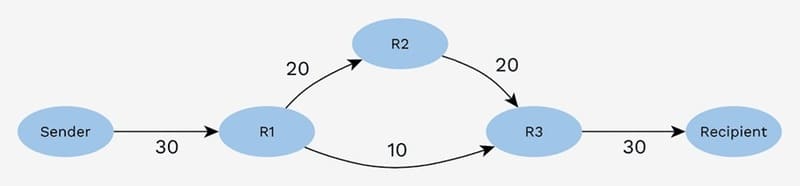
It is also possible that the actual payment was even larger and that the payee employed Multi-Path Payments (MPP). In that case, not even the routing nodes along the path would have full visibility into the total size of the transfer.
In any case, seeing payments of this scale routed with ease shows that Lightning in 2025 is far more capable and active than it was just a few years ago – despite the clamoring of second-hand pundits scrounging for Elon bucks by spinning a narrative of Lightning “stagnating.”
Their argument leans on the largely irrelevant metric of “TVL” – at best a secondary or tertiary signal, and one only cited by outsiders who don’t use the Lightning Network themselves. It’s taken at face value only by the uninformed – and by those with an agenda to sell you.
If you want real insight into how Lightning is doing, follow the people actually building on the protocol and application layers (with the necessary discernment) – or better yet, start getting involved yourself.
Expertise comes from doing the work, not from reading second-hand opinions about it.
The August 2025 Stress Test
The task:
Send dozens of Lightning payments of 0.1 BTC each within just a couple of hours.
Would the node buckle? Were our current channels and peers ready to handle it? And could the network as a whole manage the pathfinding for such – relatively large – payments in quick succession (with the higher likelihood of certain routes being exhausted)?

The results:
It passed with flying colors – we were honestly impressed with how rock-solid both our infrastructure and the Network as whole have become. The test further strengthened our conviction that we’re ready to roll out our improved Lightning Swap service to the public in the near future.
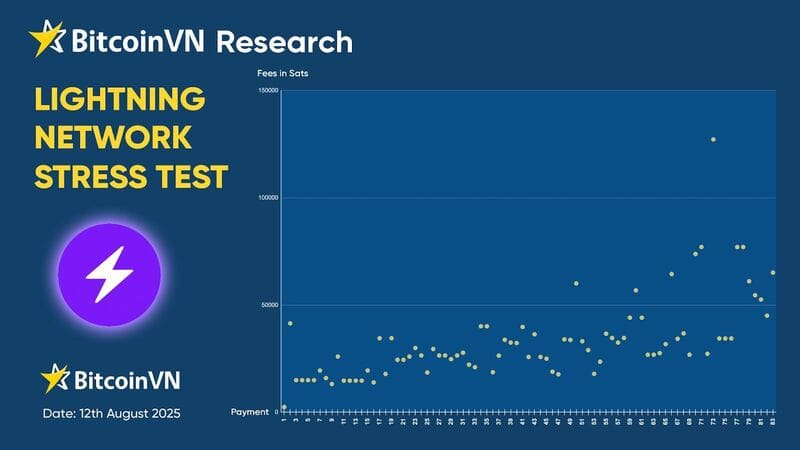
In the end, we ran the experiment over the course of 9 hours, pushing a total of 83 transactions worth approximately 8.3 BTC.
The test was not exactly cheap:
We spent around 2,758,497 sats in fees (≈ 3k$+ USD) – but the insights gained were arguably well worth the cost.
Certainly a happy day for our peers who must have seen quite a profitable spike on their end during our stress test day – but we have to hand it to them, they provided a solid service throughout the day and as such deserve the recognition and monetary reward of building out such reliable pillars in the network.

Speed?
While we didn’t track the exact number of seconds for each transaction, some went through in bare seconds, others (especially in the later stages of the experiment) took up to about 2 minutes until a routing path was successfully found.
Overall we were quite content with the speed performance, given that we repeatedly pushed $10k+ payments out towards our peers – who took the barrage of chad-sized payments like a champ.
Fee range?
Highest single fee came in at 127,180 sats (payment #73) – at a point where our peers were already getting literally exhausted.
Lowest fee was 13,211 sats (payment #9). (Or 2,500 sats if you count payment #1, which was only 5m sats in size, while Payment #2 came in at 41,482 sats for a 15m sats transfer – all other payments were set at 10m sats each).
One could probably make a neat plotting graph out of it and watch the fees rise as time went on – which we have foregone for now in the interest of simplicity to get our results released. If you’d like to see such a graph, let us know in the comments or reach out to us through the usual channels.

Reliability?
What else to say:
Not a single payment failure was recorded.
Yes, we pushed close to 1m$ worth of BTC out to our peers over the course of just a couple of hours – and every single payment routed successfully.
Credit here goes to all our peers and fellow node operators who run such a tight ship to make this performance possible, as well as to everyone from the early days until today who has contributed to making the Lightning Network as powerful, scalable, and reliable as it is today.
And we certainly haven’t seen the end of it.
—
To note:
The test was run via our TOR routing node – results on a clearnet routing node might have been different (and arguably better, at least in theory).